|
Accommodation
Packages/Specials
Activities
Boaties
CONTACT
Events
Guide
Dine Out Guide
Articles &
History
Photographs
Birds & Plants
Services
Shops/Transport
Community Groups
Travel
Ferries, Flights
Travel
Resources
|
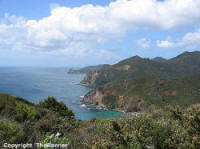 90km
north east of Auckland, just over 3 hours by ferry and 30mins by plane Great
Barrier Island (Aotea) is a 'world of its own'. Although part of
Auckland Central the island is as different to any city as you could get.
Take a trip back in time to when roads were unsealed and drivers
acknowledged one another. There are no banks, no traffic lights and
just a few shops. Water is mainly what comes from the sky and power is
generated by generator and/or alternative power systems. 90km
north east of Auckland, just over 3 hours by ferry and 30mins by plane Great
Barrier Island (Aotea) is a 'world of its own'. Although part of
Auckland Central the island is as different to any city as you could get.
Take a trip back in time to when roads were unsealed and drivers
acknowledged one another. There are no banks, no traffic lights and
just a few shops. Water is mainly what comes from the sky and power is
generated by generator and/or alternative power systems.
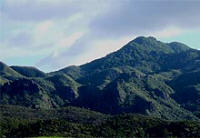 On
the west coast of the island steep, forest covered ranges climb to
Hirakimata, the highest peak at 621m. On the eastern coast sweeping
white sand beaches, tidal creeks and wetlands. The absence of possums
allows plant life to flourish and Great Barrier Island has an impressive
variety of birds, many of which are threatened and endangered.
Hirakimata (Mt Hobson) is a mountain of
significance in Ngati Wai oral tradition and identity. 'Hi-raki-ma-ta'
literally means 'lightning striking the cliff'. On
the west coast of the island steep, forest covered ranges climb to
Hirakimata, the highest peak at 621m. On the eastern coast sweeping
white sand beaches, tidal creeks and wetlands. The absence of possums
allows plant life to flourish and Great Barrier Island has an impressive
variety of birds, many of which are threatened and endangered.
Hirakimata (Mt Hobson) is a mountain of
significance in Ngati Wai oral tradition and identity. 'Hi-raki-ma-ta'
literally means 'lightning striking the cliff'.
Although once logged much of the island is now
covered with regenerating
forest and bush and some fine stands of kauri still remain.
In June 2014 the
last remaining
Kauri Dam
was destroyed in a storm which caused extensive damage to roads and tracks
at the northern end of the island.
There
is a variety of walking tracks from a short walk to visit a
waterfall or some
hot springs to the longer walk taking you to the
highest most point
of the island.
View the
regenerating forest of native trees, and enjoy
the unspoilt natural beauty along with
panoramic views.
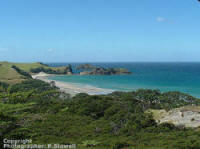 From beaches to sheltered bays and steep
forest covered hills to mangrove estuaries the Barrier has a diverse
landscape. The brown teal duck, black petrel, North Island
kaka, banded rail, NZ dotterel and chevron skink are just some of
the endangered species this habitat provides for. From beaches to sheltered bays and steep
forest covered hills to mangrove estuaries the Barrier has a diverse
landscape. The brown teal duck, black petrel, North Island
kaka, banded rail, NZ dotterel and chevron skink are just some of
the endangered species this habitat provides for.
There is
always a welcoming smile and a hand of friendship for visitors to
this small Barrier community of about 900. The pace of life is
slower here usually and things don't always happen on time,
they happen in 'Barrier time'. This is a unique and special
place not just b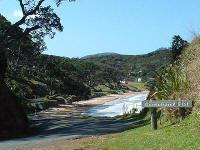 ecause of it's beauty but for the tranquillity, the
peace and quiet it has to offer all who wish to experience it. ecause of it's beauty but for the tranquillity, the
peace and quiet it has to offer all who wish to experience it.
Great Barrier Island was named such by Captain Cook who sighted the
island whilst sailing, on the Endeavour,up from the Firth of Thames
and crossing the Hauraki Gulf between Cape Colville and Point Rodney
on 23rd November 1769. Aotea is the Maori name for the island.
PREDATORS: to
the native flora and fauna on Great Barrier Island |
