|
Native Birds Photo Gallery
Copyright © 2002 GBINZ |
||
|
Birds | Island Scenery |
||
|
Photographs of some of Great Barrier Island's abundant birdlife, the endangered brown teal, wood pigeons, banded rails, kingfishers, kaka and more. |
||
|
Photographer: K.Stowell unless otherwise noted. |
||
|
|
|
|
|
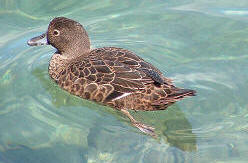
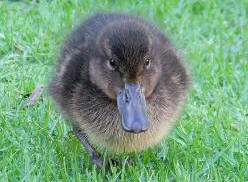
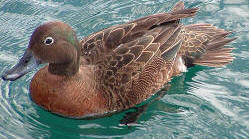
Brown Teal Duck - Pateke |
||
 |
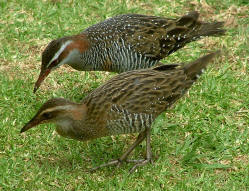 |
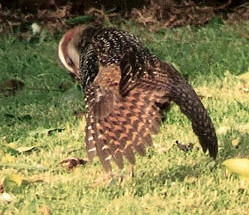
Banded Rail - Moho-pereru |
 |
 |
 |
|
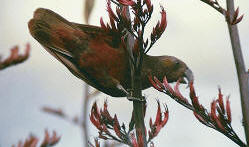
Kaka Brown with crimson underneath and under the wings. A noisy bird of the parrot family the kaka can be seen flying and circling above the bush, calling to one another over the summer months. Insects form their main diet supplemented with the nectar of the flax flowers as well as the seeds of the cones of native and non native trees. |
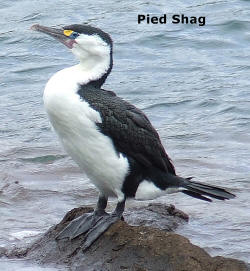
Pied Shag - Karuhiruhi Black above face from above the eye, underneath white, black thighs, grey bill, blue ring around eye, black feet. A coastal, sea fishing bird also found in estuaries and up rivers. Feeds large on fish diving in still water, shallows and currents. |
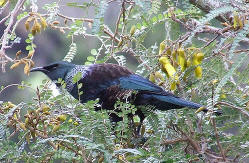
Tui Greenish blue colouring with a lacy collar of white and a prominent white tufts at the throat. The black bill is curved and the feet are grey. Known for their beautiful song the tui is one endemic bird that has thrived despite the introduction of humans to their environment. They are aggressive birds with clearly defined territories who will chase other birds away including larger birds like the kaka. |
 |
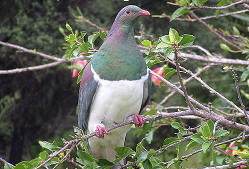 |
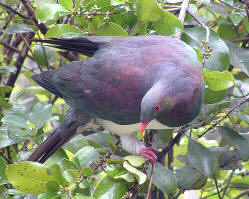
Wood Pigeon - Kereru |
 |
 |
 |
|
NZ
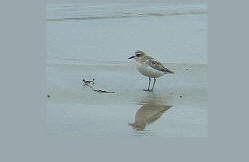
Dotterel - Tuturiwhatu |
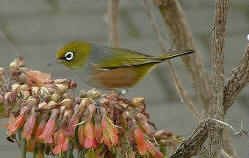
Silvereye
(Waxeye) - Tauhou |
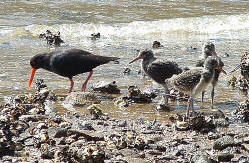
Variable Oyster Catcher- Toreapango |
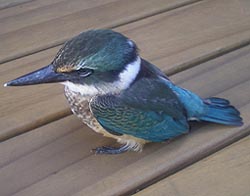 Photographer: Ken Hollis |
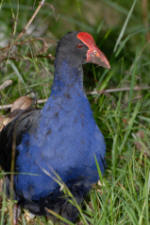 Photographer: © Simon Fordham |
 |
|
Kingfisher - Kotare |
NZ Swamp Hen - Pukeko With a deep blue body with some green and black on their wings, white under their tail, a prominent blunt bright red bill and orange legs these birds are not easily missed. Mainly found around swamps and estuaries they have a diet of insects, frogs, small birds and eggs. Pukeko are a member of the rail family which includes weka. |
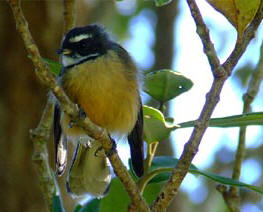
Fantail - Piwakawaka A fairly common bird the fantail has a long black and white fanned tail, a grey head with browny yellow underneath. This insect eating bird is inquisitive and relatively fearless. A familiar sight for bush walkers as it flits around the bush. |
 Photographer: © Simon Fordham |
 Photographer: © Simon Fordham |
 |
|
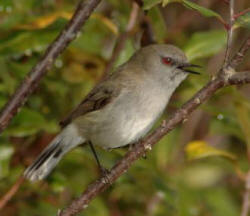
Grey Warbler
- Riroriro A grey bird with conspicuous white tipped tail. Their nest is pear-shaped and set in dense bush and the eggs are sometimes freckled like a wren. The second nest built by the warbler is often usurped by the shining cuckoo which places its egg for the warbler to look after and raise the young. |
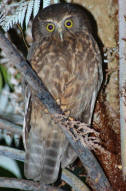
Morepork
- Ruru Has a larger head and longer tail than a small owl. Dark brown, spotted and barred with a buff colour and yellow eyes. The ruru is an important part of Maori mythology and tradition. Their menu includes moths and beetles as well as small animals such as mice, baby rats, lizards and birds usually no larger than themselves. |
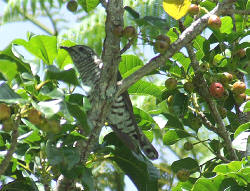
Shining Cuckoo
- Pipiwharauroa Has distinctive stripes on the face underside and the back is green. This bird lays it’s eggs but doesn’t build a nest or rear its young. When the cuckoo arrives around September it places its eggs in the nest of a grey warbler for them to raise. The cuckoo is too large to enter the warblers nest so uses its beak to place the eggs in the nest. |
 Photographer: B. Welch |
|
|
|
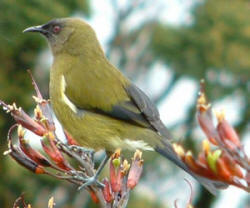
Bellbird -
Korimako The male is olive green, with a pale underside and red eyes. Its tail and wings are a dark blue. The female is browner with a short curved bill. Bellbirds have a flue-like song and are often the song is mistaken for a tui. They are territorial during breeding season and females will attack intruders when defending their nest. grey bird with conspicuous white tipped tail. |
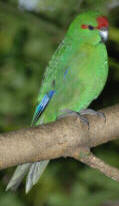
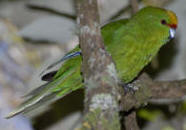
Kakariki Yellow-crowned parakeet and Red-crowned parakeet. The red-crowned Kakariki has a bright crimson forehead, crown and a streak through the eye, purple-blue on the wings and the yellow-crowned has a golden yellow crown. Kakariki have long tails and a yellow or red crown. Usually bright green in colour with long tails. They favour holes in branches and trunks of trees for nesting. |
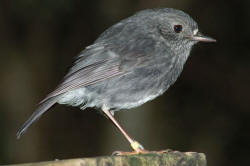
North Island Robin
- Toutouwai Dark grey with long thin legs. The male is almost black with a pale grey breast whereas the female and juveniles are greyer. They feed on small insects, worms and grubs. Robins breed in October/November usually building their large, compact nests in a tree, sometimes the kiekie. |
 Photographer: © Simon Fordham |
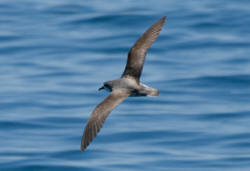 Photographer: © Simon Fordham |
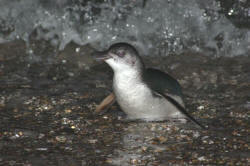 Photographer: © Simon Fordham |
|
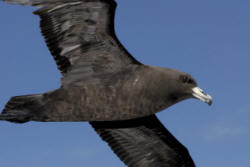
Black Petrel The black petrel, an endemic seabird, formerly found across the North Island and north-western South Island ranges, are now restricted to Great Barrier and Little Barrier Islands. The main breeding area on Great Barrier Island is around the highest point, Hirakimata (Mt Hobson). Once safely fledged it will head for South America to live off the sea for the next four to five years and then will return to the very same area where it was born and look for a mate. |
Cooks Petrel Have a white forehead, cheeks and underparts while their back is pale grey. Their bill is long and black, legs and feet blue. They breed from October through to May and then migrate to the eastern Pacific from California to Chile. |
Blue Penguin - Korora The smallest penguin with blue back and along the sides of the face near to the eye. White underneath. Small and vulnerable they generally come ashore after sunset and their raucous braying can be heard along the shoreline. With webbed feet acting like paddles they are really fast in the water. |